AI customer service software is transforming how businesses support, engage, and retain their customers. Instead of long wait times, repetitive questions, and overloaded teams, AI ,especially emerging tools like voice bot AI ,brings fast, accurate, and personalized service at scale. When implemented thoughtfully, it becomes a growth engine, not just a cost center.
This guide explains what AI customer service software is, why every growing business needs AI in its call center, the benefits it delivers, the features that matter, and how to successfully roll it out in your organization.
How Modern Technologies Strengthen AI Customer Service Software
Today’s AI customer service software is supported by a larger ecosystem of advanced digital innovations that boost efficiency, intelligence, and scalability across the entire customer journey.
AI-powered cloud infrastructure allows contact centers to expand on demand, manage fluctuating call volumes, and run sophisticated voice bot AI tools without heavy hardware investments. By processing and analyzing data instantly across distributed systems, businesses can deliver fast, continuous support without performance bottlenecks.
Meanwhile, improvements in next-generation computing systems ,including high-performance processors and real-time data frameworks ,enhance how AI interprets customer intent, automates workflows, and resolves complex issues. This computing strength ensures that even challenging service scenarios are handled accurately and without delay.
AI is also transforming growth strategies. With AI-driven digital marketing, companies can personalize communications, anticipate customer behavior, and automate large-scale campaigns. These intelligent marketing platforms integrate seamlessly with call center AI, providing rich insights about buyer interests, sentiment shifts, and engagement patterns. This shared intelligence empowers both human agents and AI systems to offer more relevant, contextual support.
In addition, AI-enhanced financial analytics give businesses real-time visibility into support costs, revenue impact, customer value, and operational trends. When connected to AI customer service platforms, these financial insights help leaders optimize resources, forecast demand, and quantify the ROI of automation.
Together, these technologies form a unified backbone that enables AI-driven call centers to operate faster, smarter, and more profitably ,making them essential for every growing business.
What Is AI Customer Service Software?
AI customer service softwareis a set of tools and technologies that use artificial intelligence to handle, assist with, or enhance customer support interactions. It can understand questions, suggest answers, automate repetitive tasks, and help human agents resolve issues faster and more accurately.
Typical components include:
- AI chatbots and virtual assistantsthat handle common questions in real time.
- AI email and message triagethat classifies, routes, and prioritizes incoming requests.
- Knowledge base searchpowered by natural language understanding, so customers and agents find answers quickly.
- Agent assist toolsthat suggest replies, surface relevant articles, and summarize conversations.
- Analytics and insightsthat reveal trends, recurring issues, and opportunities to improve products or processes.
Unlike traditional rule based automation, modern AI can interpret natural language, adapt to new scenarios, and learn from historical interactions to continuously improve.
Top AI Customer Service Software Solutions for Growing Businesses
Choosing the right AI customer service software can make the difference between a reactive support team and a proactive growth engine. Here are some of the top platforms in the market today:
- Bright Pattern
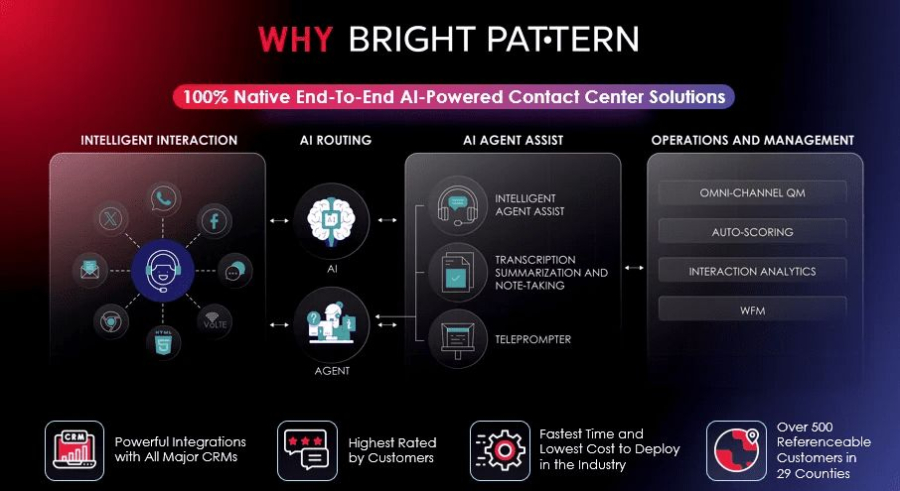
Bright Pattern offers an all-in-one AI customer service platform designed to streamline call centers, chat, email, and social messaging. Its voice bot AI capabilities allow businesses to handle high call volumes efficiently while maintaining personalized, human-like interactions. Bright Pattern integrates seamlessly with CRM systems, marketing platforms, and analytics tools, giving organizations a single source of truth for customer engagement. Its omnichannel approach ensures consistent experiences across every touchpoint, reducing wait times and improving customer satisfaction. Enterprises also benefit from real-time reporting, AI-driven routing, and intelligent workflow automation, making it ideal for growing businesses that want scalable, AI-powered customer support. - Genesys Cloud CX
Known for its robust AI and workforce optimization tools, Genesys Cloud CX combines voice, chat, email, and social support with predictive routing and automation.
- Five9 Intelligent Cloud Contact Center
Offers AI-assisted agent tools, predictive dialing, and automation to help call centers improve efficiency and reduce operational costs.
- Zendesk Suite
Provides AI-powered ticketing, chatbots, and analytics to support multichannel customer service operations.
- Talkdesk CX Cloud
Features AI-driven automation, workflow optimization, and real-time reporting for omnichannel support.
- Freshworks Freshdesk
Includes AI chatbots, automated workflows, and a unified ticketing system to streamline customer support.
- Salesforce Service Cloud
Combines AI analytics, chatbots, and process automation for high-level, enterprise-grade customer support.
- Cisco Contact Center
Offers AI-based agent assistance, predictive analytics, and omnichannel routing for large-scale organizations.
- Amazon Connect
Cloud-based contact center with AI capabilities like natural language chatbots, voice recognition, and machine learning insights.
Key Benefits for Modern Support Teams
Implemented well, AI customer service software delivers benefits that span the entire business, from support operations to sales and customer success.
1. Faster Response Times
AI can respond instantly to many questions, reducing queues and wait times. Even when a human agent is required, AI can collect context upfront and route the request to the right person, significantly shortening resolution times.
- Instant answers to simple, repetitive questions.
- Pre filled context for agents before they join the conversation.
- Intelligent routing to the best suited agent or team.
2. 24/7, Always On Support
AI powered support channels do not sleep. Customers can get help at any time, across time zones and holidays, without needing to expand headcount around the clock.
- Global coverage without fully staffed night shifts.
- Consistent experience regardless of traffic spikes.
- Greater satisfaction for customers who prefer self service.
3. Higher Agent Productivity and Morale
AI automates repetitive tasks, allowing agents to focus on more rewarding, high value work such as solving complex problems and building relationships.
- Reduced time spent on copy paste tasks and manual lookups.
- Smart suggestions that cut down on typing and research time.
- Lower burnout and turnover as agents handle more meaningful cases.
4. Consistent, High Quality Answers
AI customer service software draws from a centralized knowledge base and approved templates, so customers receive accurate and consistent responses across channels and agents.
- Reduced risk of contradictory or outdated advice.
- Automated compliance with tone, policy, and legal guidelines.
- Easier updates: change the source content once, and AI reflects it everywhere.
5. Scalable Support Without Linear Costs
As your customer base grows, AI absorbs a significant share of new interactions, so you do not have to grow your support team at the same rate.
- Handle peak volumes, product launches, or seasonal spikes without chaos.
- Serve more customers with the same size team.
- Reinvest savings into higher impact initiatives, such as proactive support or customer success.
6. Deeper Insights into Customer Needs
Every interaction your AI tools handle can be analyzed to uncover trends, pain points, and opportunities.
- Identify recurring issues that signal product improvements.
- Spot at risk customers based on language and sentiment.
- Understand which topics consume the most time and energy.
Core Features to Look For in AI Customer Service Software
Not all AI tools are created equal. When evaluating solutions, focus on capabilities that drive real operational and customer experience benefits.
1. Natural Language Understanding (NLU)
The AI should understand how real customers speak, not just keywords. Strong NLU capabilities allow the system to interpret intent even when phrasing is imperfect, emotional, or mixed with multiple questions.
2. Omnichannel Support
Customers switch channels freely. Ideally, your AI customer service software can operate across:
- Website and in app chat.
- Email and contact forms.
- Messaging platforms and social channels.
- Voice or phone integrations via speech to text and text to speech.
Omnichannel support helps you deliver consistent experiences, no matter how customers choose to reach out.
3. Self Service and Knowledge Management
A powerful knowledge engine helps both customers and agents. Look for:
- AI enhanced search that understands natural language queries.
- Automatic suggestions of relevant articles during conversations.
- Tools to keep content up to date and easy to maintain.
4. Agent Assist and Co Pilot Features
AI should workwithyour agents, not just in front of them. Agent assist features can include:
- Suggested replies that agents can edit and send.
- Real time recommendations from existing tickets or documentation.
- Automatic summaries of long threads or call transcripts.
5. Intelligent Routing and Prioritization
AI can analyze message content, customer history, and sentiment to route and prioritize tickets.
- Match complex issues with senior agents.
- Fast track high value accounts or urgent problems.
- Balance workloads across teams during busy periods.
6. Automation and Workflows
Beyond answering questions, AI should be able to trigger workflows, update records, and coordinate processes across systems.
- Automatic ticket creation and classification.
- Status updates, follow ups, and reminders.
- Integrations with CRM, billing, or order management tools.
7. Analytics, Reporting, and Feedback Loops
Insight is where AI truly shines. Look for:
- Dashboards showing volume, resolution rates, and response times.
- Customer satisfaction and sentiment analysis.
- Feedback tools that allow agents to correct or improve AI suggestions.
Real World Use Cases for AI Customer Service Software
AI customer service software can be applied across industries and business models. Here are common scenarios where organizations see strong returns.
1. Handling High Volume, Repetitive Questions
Questions like “Where is my order?”, “How do I reset my password?”, or “What is your return policy?” appear thousands of times. AI can handle these instantly, with consistent, accurate answers.
2. Intelligent Pre Sales Support
Potential customers often reach out through support channels with product, pricing, and compatibility questions. AI can qualify these inquiries, provide helpful information, and seamlessly introduce human sales or support specialists when needed.
3. Proactive Support and Notifications
AI can detect patterns that signal customers might be confused, stuck, or frustrated. It can trigger proactive messages, suggest helpful content, or recommend outreach from your team before a ticket is even created.
4. Technical Troubleshooting Assistance
For more complex issues, AI can guide customers through structured troubleshooting flows, collect logs or screenshots, and summarize key details for an expert to review, dramatically speeding up resolution.
5. Support for Global, Multilingual Audiences
With language detection and translation capabilities, AI can help you support customers around the world without hiring full teams in every language. Agents can reply in their primary language while customers see messages translated into their own.
How AI Enhances Each Stage of the Customer Journey
AI customer service software adds value before, during, and after the sale.
|
Stage |
Customer Need |
AI Powered Support |
|
Awareness |
Basic product information, quick answers. |
Chatbots answering common questions and guiding visitors. |
|
Consideration |
Detailed comparisons, suitability checks. |
AI assisted product recommendations and content suggestions. |
|
Purchase |
Checkout help, pricing clarity, policy questions. |
Real time support during checkout and instant clarification on terms. |
|
Onboarding |
Guided setup, first success milestones. |
Interactive tutorials, in app assistants, and contextual tips. |
|
Usage |
How to questions, troubleshooting, optimization. |
Self service knowledge, agent assist, and proactive tips. |
|
Renewal and Expansion |
Value confirmation, upgrade decisions. |
Usage insights, satisfaction signals, and targeted outreach triggers. |
Implementing AI Customer Service Software Step by Step
A successful rollout is as much about strategy and change management as it is about technology. The following steps help you introduce AI in a way that wins both customer and team buy in.
Step 1: Define Clear Objectives
Start by deciding what you want AI to achieve. Examples include:
- Reduce first response times by a specific percentage.
- Increase self service resolution for common issues.
- Improve agent productivity or reduce handle time.
- Extend service coverage without adding headcount.
Well defined goals guide feature selection, configuration, and success measurement.
Step 2: Map Common Customer Journeys and Use Cases
Identify the most frequent and impactful interactions:
- Top contact reasons and ticket categories.
- Steps customers take before contacting support.
- Issues that create the most friction or dissatisfaction.
Begin with use cases that are high volume and low to medium complexity. This maximizes impact while limiting risk.
Step 3: Prepare and Centralize Knowledge
AI is only as good as the information it has. Invest time in:
- Auditing existing articles, macros, and internal docs.
- Retiring outdated content and consolidating duplicates.
- Structuring information clearly so AI can reference it effectively.
Step 4: Start with a Pilot
Roll out AI to a limited set of use cases, channels, or customer segments. During the pilot:
- Monitor response quality and resolution rates closely.
- Invite agents to review and rate AI suggestions.
- Collect feedback from customers on clarity and helpfulness.
This controlled approach lets you fine tune the system before scaling.
Step 5: Refine, Expand, and Automate More
Based on pilot results:
- Adjust conversation flows, responses, and escalation rules.
- Expand coverage to more topics and languages.
- Automate additional workflows, such as follow up emails or surveys.
Step 6: Integrate with Your Broader Tech Stack
For maximum value, connect AI customer service software with other systems such as CRM, order management, billing, or marketing tools. Integrations allow AI to:
- Access relevant customer data to personalize replies.
- Perform actions, such as updating an address or modifying a subscription.
- Share insights with other teams, such as product or marketing.
Change Management and Agent Enablement
To unlock the full potential of AI, your agents need to see it as a partner, not a threat. Thoughtful change management ensures adoption and long term success.
Involve Agents Early
Invite frontline agents to participate in testing, training, and content creation. They understand customer pain points deeply and can spot gaps in AI responses quickly.
Position AI as a Co Worker
Clearly communicate that AI is there to remove drudgery and empower agents, not replace them. Highlight how it will help them:
- Spend more time on meaningful, complex cases.
- Grow skills in problem solving and relationship building.
- Reduce stress from queues and repetitive questions.
Provide Training and Clear Guidelines
Train agents on how to use AI tools effectively, including:
- When to accept, adapt, or override AI suggestions.
- How to flag and correct inaccurate or unhelpful responses.
- How to report patterns or gaps so the system improves over time.
Measuring Success: Key Metrics and KPIs
To demonstrate the value of AI customer service software, track metrics that tie directly to your objectives.
Operational Metrics
- First Response Timefor each channel.
- Average Handle Timefor humans, with and without AI support.
- Self Service Resolution Rateand deflection rate.
- Ticket Backlogand queue lengths during peak times.
Experience and Quality Metrics
- Customer Satisfactionscores for AI handled and human handled interactions.
- Net Promoter Scoreand sentiment trends over time.
- First Contact Resolutionrates.
Business Impact Metrics
- Cost per contact and overall support cost trends.
- Retention and renewal rates for supported customers.
- Conversion or upsell rates influenced by AI assisted conversations.
How to Choose the Right AI Customer Service Platform
Selecting the right solution is a strategic decision. Consider the following factors.
Alignment with Your Use Cases
Ensure the platform supports your highest priority scenarios, such as chat automation, email assistance, or voice support, and can grow with your roadmap.
Ease of Use and Setup
Look for tools that your team can configure and maintain without constant developer involvement. A friendly interface encourages experimentation and rapid iteration.
Integration Capabilities
Check that the software can connect with your existing systems for identity, customer data, ticketing, and analytics. Smooth integrations enable more personalized and powerful experiences.
Control, Governance, and Security
Your provider should support:
- Data access controls and role based permissions.
- Privacy protections and clear data handling policies.
- Auditability and oversight on AI decisions and changes.
Adaptability and Ongoing Improvement
AI is not static. Choose software that allows you to refine responses, adjust behavior, and incorporate feedback over time, without rebuilding everything from scratch.
Future Trends in AI Powered Customer Service
AI customer service software is evolving quickly. Staying aware of emerging trends helps you build a future ready support strategy.
More Humanlike Conversations
Advances in language models are making AI conversations more natural, contextual, and helpful. Customers increasingly expect AI to understand nuance and handle richer, multi step interactions.
Proactive and Predictive Support
Instead of waiting for customers to ask for help, AI will increasingly predict needs and offer assistance in advance, based on behavior, usage patterns, and historical data.
Tighter Collaboration Between Humans and AI
Agent assist and co pilot experiences will become more sophisticated, helping agents compose responses, research complex issues, and coordinate across teams seamlessly.
Greater Focus on Ethics and Transparency
As AI plays a larger role in customer experiences, organizations will prioritize transparency, fairness, and control. Clear disclosures, opt outs, and human escalation paths will become standard expectations.
Frequently Asked Questions About AI Customer Service Software
Will AI replace human customer service agents?
AI is best at handling repetitive, structured tasks at scale. Human agents excel at empathy, judgment, and complex problem solving. The most effective strategies combine both, with AI taking on routine work and agents focusing on higher value interactions.
How long does it take to see results?
Timelines vary, but many organizations start seeing measurable improvements in response times and self service rates within weeks of a targeted pilot. Larger, more complex deployments may take longer, but early quick wins are common when you focus on high volume use cases first.
Is AI customer service only for large enterprises?
No. Modern AI customer service tools are accessible to companies of all sizes. Smaller teams often benefit significantly, because AI helps them deliver enterprise grade support without a large headcount.
What about data privacy and security?
Responsible AI providers offer robust security measures and clear data handling practices. As a buyer, you should review these carefully and configure access controls, retention policies, and governance processes that align with your own standards.
Conclusion: Turning Support into a Strategic Advantage
AI customer service software is more than a way to reduce costs. Used thoughtfully, it becomes a powerful engine for customer satisfaction, loyalty, and growth.
By blending AI driven automation with human empathy and expertise, you can deliver faster, more personalized support at scale, empower your agents, and unlock insights that shape better products and experiences.
The organizations that win the next era of customer experience will be those that embrace AI as a strategic partner in serving, delighting, and retaining their customers.
